IAU Hands-On Workshops (I-HOW): Local Volume Cosmology
19 - 30 October 2026, La Plata, Argentina
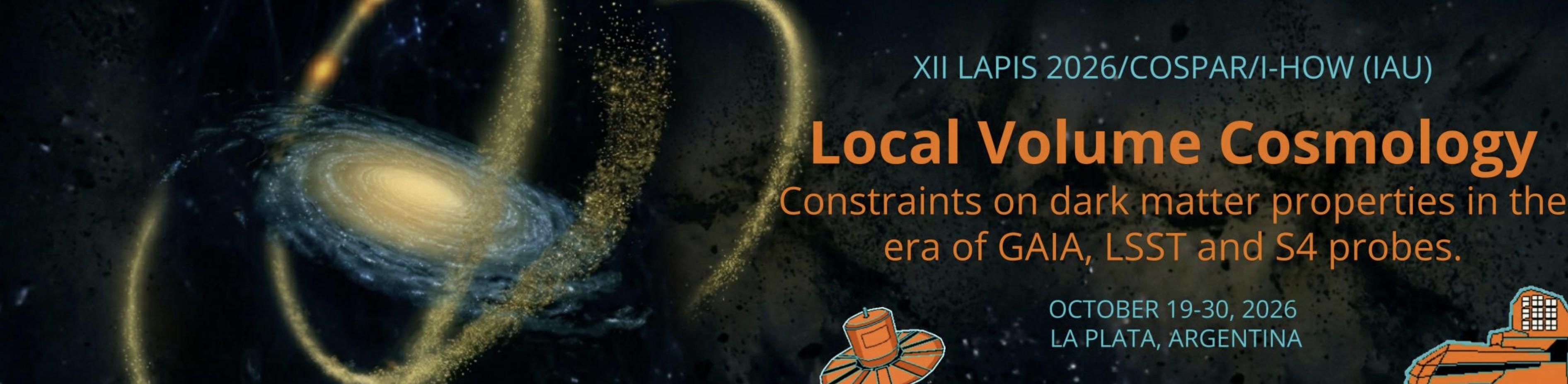
XII LAPIS 2026/COSPAR/I-HOW "Local Volume Cosmology" is entering a new era driven by the extraordinary quantity and precision of modern astronomical surveys. New datasets are transforming our understanding of nearby galaxies, stellar structures, and the small-scale distribution of dark matter.
This school will provide an overview of current challenges and opportunities in the field, with a particular focus on the synergy between precise astrometry from Gaia, deep wide-field photometry from the Vera C. Rubin Observatory (LSST), and upcoming spectroscopic surveys. Together, these data are enabling new tests of the Λ-CDM model on small scales.
The program will combine lectures by international experts with hands-on sessions using public datasets and simulations. Poster sessions and short student presentations will foster discussion and collaboration among participants.
The school is designed for about 60 advanced students and early-career researchers from Argentina and neighbouring countries.
🖊️ Register by 30 June 2026
Topics
The school will cover key topics in Local Volume cosmology, including:
- Dwarf galaxies with resolved stellar populations in the Milky Way and M31, using data from Gaia DR3 and Rubin Observatory (LSST) together with cosmological simulations
- Stellar streams as probes of galaxy assembly, the Galactic potential, and dark matter substructure
- Numerical modelling of tidal streams and galactic dynamics, using modern N-body techniques and tools such as PeTar, StreamSim, StreamSculptor, Agama, Galpy, Gala, and Dynamigal
- Constraints on dark matter physics from nearby galaxies and their satellites
- Metal-poor stars in the halo, dwarf galaxies, and streams as tracers of early galaxy formation
- Extending near-field cosmology beyond the Local Group
- The cosmological origin and direct detection of dark matter
Important dates
- May 4, 2026: Registration opens
- June 30, 2026: Registration closes
- July 2026: Announcement of selected participants and financial support decisions
Contact
📧 [email protected]